Some patients have insight and still cannot break the pattern.
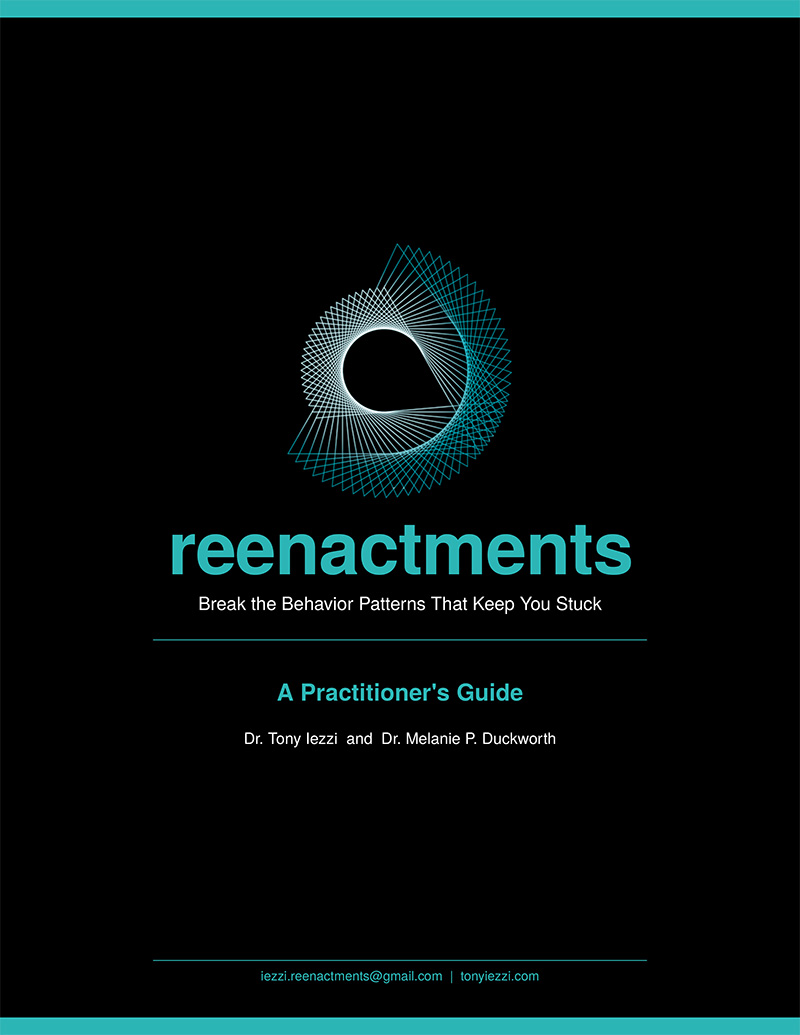
A clinical reference for the Reenactments framework, free for clinicians. From Dr. Tony Iezzi and Dr. Melanie P. Duckworth, drawing on 35 years of clinical work in behavioral medicine.
Get the Practitioner’s Guide
7-page clinical reference. Free for clinicians.
The guide is free. You will receive the PDF and an occasional email from Dr. Iezzi with case observations and clinical applications. Unsubscribe at any time.
Why insight is not enough
A patient walks into session, recounts an argument with their spouse, and says:
“I know exactly where this comes from. It is the same thing my mother used to do to me.”
They have insight. They can trace the pattern. They can name the origin. And they still had the argument.
Insight is a starting point, not the treatment. Patients who have done significant insight-oriented work and still cycle through the same presentations need a structure for converting what they know into what they do.
Reenactments is that structure. The framework Dr. Tony Iezzi and Dr. Melanie P. Duckworth developed across 35 years of clinical practice gives clinicians a five-step decision-making process, a Decision Matrix for mapping patient responses, and a clinical themes reference for naming what is operating underneath the pattern.
A 7-page clinical reference, designed to be used.
A 7-page clinical reference designed to be read in under 15 minutes and used as a working resource. Print it, save it to your clinical files, share with colleagues evaluating the framework.
- 1
The Reenactments Relational Framework.
The core model: what a reenactment is, how themes operate, and why the framework is integrative rather than CBT. - 2
Reenactment Themes Quick Reference.
A clinical table covering ten of the most commonly observed themes, each paired with its typical presentation in session. - 3
The Five-Step Break-Your-Reenactment Process.
The core clinical tool. Identify, Regulate, Track Themes, Analyze and Decide, Engage and Review. Each step paired with a client prompt and clinical function. - 4
The Reenactment Decision Matrix.
A two-axis tool for mapping patient responses to triggers. Includes session use, journaling protocol, and the key distinction between deliberate inaction and avoidance. - 5
Clinical Applications.
How the framework applies across trauma, chronic pain and behavioral medicine, interpersonal difficulties, depression and anxiety, and group therapy. - 6
Bibliotherapy notes.
How to use the book as a between-session adjunct and which chapters introduce which tools. - 7
Bulk ordering for clinical practices and institutions.
Written for clinicians evaluating the framework.
The Practitioner’s Guide is for clinicians evaluating Reenactments for use with their patients or as a between-session adjunct. The framework applies across a wide range of presenting problems and does not require a specific therapeutic orientation.
35 years of clinical practice, distilled.
The Reenactments framework was developed by Dr. Tony Iezzi (clinical psychologist with 35 years of behavioral medicine practice at a large medical hospital) and Dr. Melanie P. Duckworth (clinical psychologist and Executive Director of the Office of Diversity, Equity, and Inclusion at the University of Nevada, Reno). It draws on practice in chronic pain, trauma, and bariatric surgery programs. It is integrative, not protocol-based, and does not require a specific therapeutic orientation to use as an adjunct.

Written for clinicians evaluating the framework.
Dr. Tony Iezzi | iezzi.reenactments@gmail.com | tonyiezzi.com
Facebook: Breaking Reenactments | Instagram: @iezzi.reenactments
Copyright 2026 Tony Iezzi, Ph.D. and Melanie P. Duckworth, Ph.D.