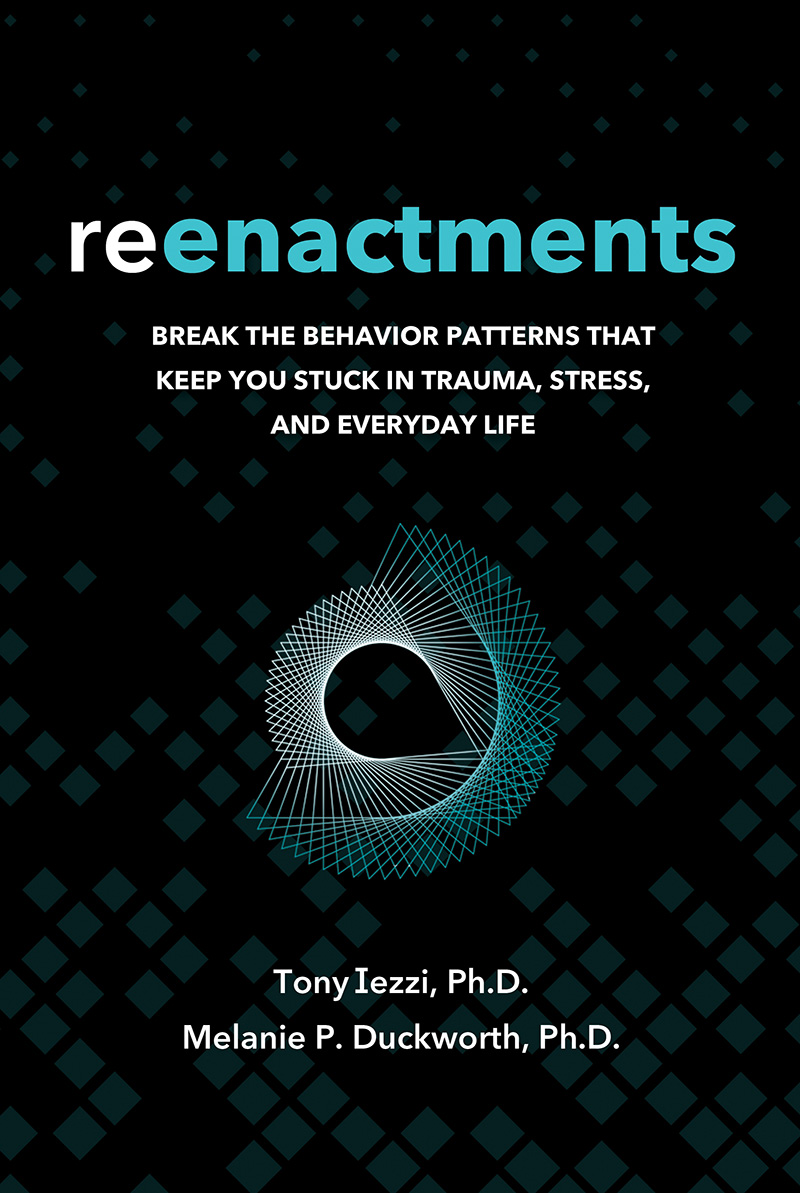
The first thing I noticed about Reenactments: Break the Behavior Patterns That Keep You Stuck in Trauma, Stress, and Everyday Life, by Iezzi and Duckworth, was the ease of reading. It was like having a conversation with a familiar and wise friend; I did not get bogged down with a sense of being lectured to or feel the pressure of being sold a model that solves all the problems. Instead, it is a comfortable integration of information across many disciplines, providing a framework to think about the self and how we interact with the world. It highlights the importance of awareness and the power we have to change the way we act, even when the way we react is deeply rooted in our physiological and psychological makeup. The authors explore the early developmental foundations of the way we relate to the world, and relationships in particular, without a sense of blaming or forfeiting self-efficacy – we are not stuck because we cannot change the way our stories started. Still, we do need to understand our stories to work toward change.
The breadth of the information that is integrated into this model, while remaining cohesive and sound, is impressive. The authors reference well-established theories such as attachment theory, polyvagal theory, the generalized uncertainty theory of stress, social safety theory, as well as philosophies such as Buddhism, and seminal works such as Viktor Frankl’s Man’s Search for Meaning. It is made easy for the reader to move past elements that do not resonate at the time, or to delve more deeply into the elements that land for them. This is the type of book that you re-read many times; each time you will walk away with a deeper understanding of self and a more solid framework of how to move forward with continuing the journey of increasing awareness.
As a clinician with over 20 years of experience in clinical psychology, I have found the model of reenactments to be a valuable framework for deepening my understanding of patients who present as “stuck” and for guiding conversations that foster shifts in understanding and focus. I, too, have often struggled with patients who have “processed their index trauma” and remain dysregulated and easily triggered; connecting the identified trauma to core reenactments provides a useful bridge. The flexibility of identifying core reenactments not only as objectively traumatic events but rather as themes that have been started early and reinforced repeatedly broadens the examination. The model helps patients see the usefulness of this early exploration without feeling exploited or as though they are looking in the wrong direction. I have already shared the metaphor of Linnie, who starts her journey with three books in her book sack, with a patient who was struggling to understand why she kept coming back to self-perceived “minor” events in her childhood. The idea that new books are added, and books get weightier in our book sack as we travel through life, resonates, providing “aha” moments for patients who need a new perspective to move through established habitual responses.
Finally, I appreciate that the reenactment model is not posed as a panacea or a manualized approach to understanding one’s psychological makeup. In its very foundation is the awareness that each individual is unique; each journey to health is therefore unique. What this book offers is a guide to exploring this uniqueness in a way that doesn’t overwhelm; it takes advantage of the wealth of pre-existing research and the vast experience of 2 skilled clinicians, and lays out the guideposts to a meaningful exploration of self and the patterns that become embedded in our behaviors. I may not have fully appreciated the wisdom within this book when I started my practice, but I certainly wish it had come across my path 10 years ago!
Dr. Tamara Biederman
Psychologist in Private Practice