

Key Takeaways
- Reenactments are specific patterns of brain, body, and mind responses to traumatic and non-traumatic experiences.
- Reenactments are triggered by underlying themes that are associated across a range of experiences.
- Reenactments have substantial physical and psychological consequences.
- Awareness is essential in identifying and breaking reenactments.
- Doing things differently leads to feeling differently.
Life naturally brings us pain and suffering. To make things worse, we often contribute to life’s hardships by creating and sustaining our own misery. We all have made some regrettable mistakes and may wonder why we keep repeating them throughout our lives. These errors are often self-inflicted and humbling. Even Eckhart Tolle, a well-known author and spiritual teacher, said, “If the structures of the human mind remain unchanged, we will always end up re-creating fundamentally the same world, the same evils, the same dysfunction.”1
If you’re feeling stuck in a dead-end job, a dysfunctional relationship, or any other difficult situation, or if you’ve ever wondered why your life isn’t what you want it to be, this article will help you understand those feelings and guide you on how to change them. Making better life choices will allow you to live your best life.
Reenactments: Recurrent Brain, Body, And Mind Responses
The reason you keep making the same mistakes is mainly because your adult choices stem from behavior patterns formed during childhood. These aren’t even conscious decisions; they’re habits developed over time. You’re often unaware of where your adult choices originate. We call these deeply rooted habits reenactments. Please note that all content about reenactments in this post is based on Iezzi and Duckworth’s book titled Reenactments: Break The Behavior Patterns That Keep You Stuck In Trauma, Stress, and Everyday Life.
A reenactment describes the specific pattern of brain, body, and mind activity associated with a particular life experience. An experience is any event, situation, or moment you go through. Experiences can happen in traumatic situations (like exposure to war) or in non-traumatic ones (such as a disagreement with a coworker), and they are almost always stressful because they leave lasting physical and emotional effects.
More specifically, a reenactment is a repeated pattern of neurophysiological, hormonal, emotional, cognitive, and behavioral responses triggered by trauma, stress, and everyday experiences. Everyone has reenactments, which happen multiple times a day. Yes, you do too. All your reenactments can be understood by identifying the who, what, where, when, and most importantly, why — known as the W5. For example, you might argue with your partner over money at a coffee shop on a Monday morning because money is being spent on unnecessary things.
Reenactment Themes: Triggers
Understanding that past experiences can lead to reenactments is crucial. These experiences shape how you interpret new situations, often seeing them as either positive or negative. However, negative triggers tend to have a stronger effect. Your experiences are influenced by the people, events, and actions around you, which are also affected by your perceptions.
Triggers can include encounters with people resembling a past aggressor, seeing events like the first snow that evoke memories of a fatal accident, or hearing fire truck sirens that remind someone of a traumatic house fire. Even watching certain TV shows can trigger memories of war, abuse, or suicide, leading to strong negative physical and emotional reactions.
Triggers can be anything—person, place, object, or situation—that provokes a reaction, often in seemingly harmless settings, like being ignored, considered, disrespected, or insulted during daily interactions at work, school, or home. All reenactments, whether traumatic or not, revolve around themes. A reenactment theme is a core topic, idea, emotion, or way of communicating that we associate with during an experience, connecting it to other experiences over time.4 Examples include abandonment, loss, uncertainty, and entrapment.
The perception of an experience influences the theme of reenactment, which can cover a wide and nearly limitless range of sensitivities. In trauma cases, triggers are usually easy to identify. For example, if a dog has mauled someone, the event involves the dog as the feared object that triggers a strong physical and emotional response. But what are the deeper themes connected to that trauma through reenactment? While feelings of helplessness and powerlessness might be clear in the experience of being mauled by a dog, what about feelings of incompetence, guilt, or even foolishness?
Like traumatic reenactments, non-traumatic experiences involving interpersonal discord, social insensitivity, isolation, and rejection can also cause various sensitivities.
Understanding reenactment themes is crucial for recognizing your behavior patterns. Although it might seem complicated or hard to identify them at first, with practice, you’ll be able to notice them quickly, whether after the event or in real-time. As you improve at recognizing these themes, you can prepare yourself by thinking about your responses in advance before facing similar situations in the future.
When you recognize reenactment themes effectively, it leads to an “aha” moment—understanding why you’ve been feeling threatened. This realization can bring relief and emotional release. However, simply recognizing these reenactments doesn’t make them disappear; you need to respond differently in future situations that trigger the same themes.
Reenactments Have Consequences: It Hurts
Reenactments can cause serious physical and mental effects. They may have both immediate and long-term impacts that affect your overall health. Finding new ways to act and think can help reduce or prevent the physical and mental strain of reenactments. Otherwise, repeatedly reliving past experiences can take a heavy toll on your body and mind, both now and later. This toll shows the ongoing stress on your body and mind as you keep trying to handle traumatic and non-traumatic challenges.
More specifically, you should recognize that poor management of your physical and psychological stress can lead to illnesses and diseases like chronic pain, cardiovascular problems, diabetes, and cancer, as well as mental health disorders such as mood disorders, thought disorders, and substance abuse issues.5 Research also shows a connection between the physical and psychological effects of ongoing stress and higher mortality rates, which can impair cardiovascular, immune, endocrine, and nervous system functions.6 Ouch!
No Growth Without Awareness: Strategies To Increase Awareness
All you possess without awareness are old behavior patterns, which lead to repeating the same poor decisions and results. Generally, the more aware you are, the more likely you are to choose strategies that differ from your usual responses. Consistently reacting to a reenactment theme in a new way can help you develop new habits. Similarly, a stronger commitment to action increases the chances of successfully breaking the reenactment.
There isn’t a single best way to boost awareness; instead, using a variety of coping strategies helps you become better prepared for different situations. Stay open-minded and adaptable with these strategies to keep enhancing your awareness. Find methods or approaches that resonate with you and fit your lifestyle. It’s more about taking control of your process and trying new behaviors rather than sticking to just one plan.
To improve your awareness, create a list of strategies that can help you better understand reenactments and how they affect you. A carefully selected set of strategies aimed at increasing awareness and insight includes journaling, bibliotherapy, therapy, meditation, mindfulness, acceptance, finding meaning and purpose, social support, and close relationships. These strategies demonstrate a link between greater self-awareness and improved physical and mental health. They will help you move away from reenactments and develop new, healthier habits for your body and mind.
Breaking Reenactments: Do Different, Be Different
Becoming aware of your reenactments—your habitual ways of feeling, acting, and being—helps you recognize patterns that may hold you back. By breaking free from these reenactments, you can stop repeating the same mistakes, lessen their impact on your behavior during trauma, stress, and everyday life, gain the freedom to live more intentionally, improve your quality of life, and possibly even extend your lifespan. How do you make better decisions and overcome reenactments?
The method for overcoming reenactments includes a 5-step analytical tool and our Reenactment Decision Matrix. This matrix guides you to discover new ways of acting and being. Applying this model can help improve your current situation, foster a better understanding of others, and contribute toward creating a better world.
- Be aware: It’s essential to understand that your analysis of a situation starts with recognizing you’re in a reenactment experience.
- Manage Your Reactions: During or after a reenactment, observe your physical, emotional, and behavioral responses, and take steps to monitor them (e.g., go for a walk, meditate, or journal).
- Identify Themes: Find potential themes in your reenactment experience and link them to past experiences that share the same theme.
- Assess Common Responses: Identify how you usually respond to these themes. Then, develop new ways to respond and examine the reasons behind this new approach.
- Try new behaviors: Experiment with different ways to respond during current or future reenactment experiences. This can enhance your physiological regulation and lessen the physical and psychological effects of these reenactments. Remember, do different, be different.
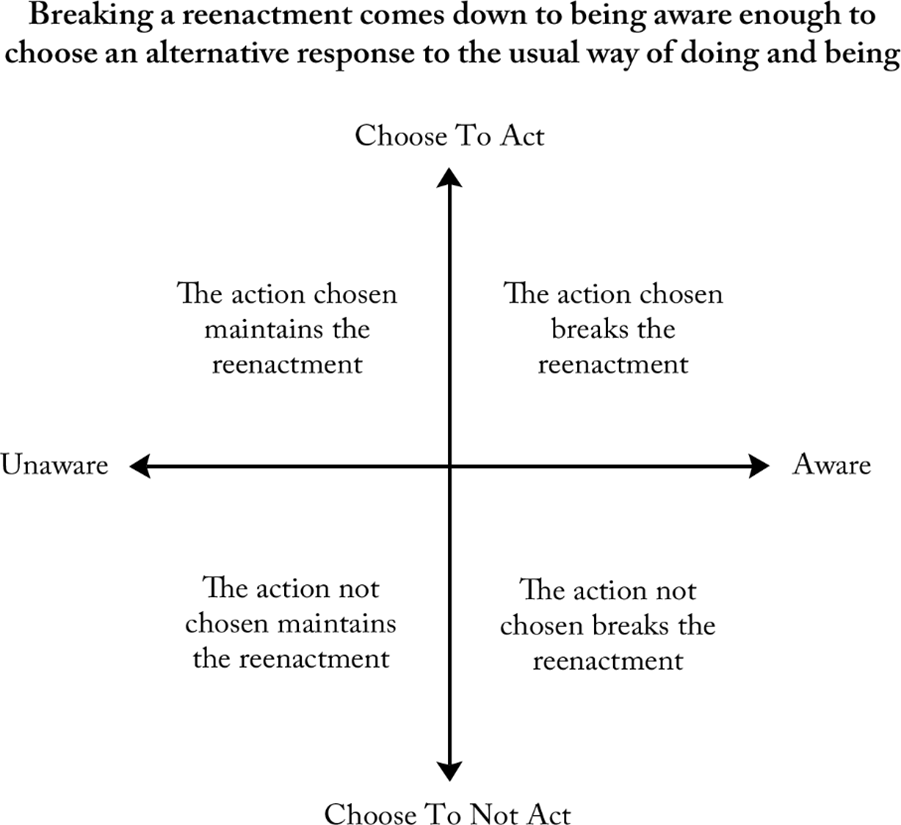
The Reenactment Decision Matrix has four possible outcomes: two positive outcomes that stop the reenactment and two negative ones that allow it to continue. The positive outcomes—located in the top and bottom quadrants on the right side of the graph—occur when you take new action or intentionally choose not to respond. Sometimes, the best option is to avoid engaging with a trigger that causes a reenactment of a past event. For example, deciding not to fulfill a request when you’ve always been accommodating can be a meaningful new behavior. This isn’t avoidance; instead, it’s a conscious, deliberate choice. What matters isn’t how the behavior appears on the surface but the reasons behind it.
On the other hand, the negative outcomes—found in the top and bottom quadrants on the left side—result from either repeating old actions or passively doing nothing. These behaviors sustain physiological and behavioral dysregulation, leading to negative consequences (reenactments).
Choose Act Chart
Compromise: The Nature Of Decision-Making
Every decision you make involves some form of compromise. What might seem like a good choice today might not seem as good tomorrow. Your understanding of what is best for you changes over time. Therefore, when you use the Reenactment Decision Matrix to choose an action, you need to recognize that each of the four options involves different compromises. You might decide today that a particular action breaks the reenactment, but tomorrow, you might believe that not acting can also break it. Ultimately, what matters most is the awareness behind your decision. Whether you choose to act or not, breaking the reenactment is a conscious choice.
Formulating and Executing A Transformation Plan
To develop your transformation plan, begin by writing a detailed life biography and keeping a journal. This helps you identify the roots of recurring patterns and provides a framework to overcome them. The plan should include creating new habits and setting goals, improving physical health, practicing meditation and mindfulness, engaging in creative activities, building and maintaining a support network, and, if necessary, seeking professional psychological help. Remember that your transformation plan should be flexible and adaptable as you grow and become your best self.
Please note that this article is a summary of our reenactments book. The following articles will expand on topics in the book and other issues beyond reenactments.
Notes
- Eckhart Tolle, A New Earth: Awakening to Your Life’s Purpose (Penguin, 2005), 22.
- Tony Iezzi and Melanie P. Duckworth, Reenactments: Break the Behavior Patterns That Keep You Stuck in Trauma, Stress, and Everyday Experiences, (London, Ontario: Amazon Kindle Direct Publishing, 2025).
- Iezzi and Duckworth, Reenactments, 7.
- Iezzi and Duckworth, Reenactments, 7.
- Jenny Guidi et al., “Allostatic Load and its Impact on Health: A Systematic Review,” Psychotherapy and Psychosomatics 90, no. 1 (2021): 11-27; Sabine Finlay et al., “Allostatic and Systemic Comorbidities in Psychiatric Disorders,” Psychoneuroendocrinology 140 (2022): https://doi.org/10.1016/j.psyneuen.2022.105726; Barbora Sporinova et al., “Association of Mental Health Disorders with Health Care Utilization and Costs Among Adults with Chronic Disease,” JAMA Network Open 2, no.8 (2019): https://doi.org/10.1001/jamanetworkopen.2019.9910; Hernando Santamaria-Garcia et al., “Allostatic Interoceptive Overload Across Psychiatric and Neurological Conditions,” Biological Psychiatry 97, no. 1 (2024): 28-40.
- Eli Puterman et al., “Predicting Mortality from 57 Economic, Behavioral, Social, and Psychological Factors,” PNAS 117, no. 28 (2020): 16273-16282.